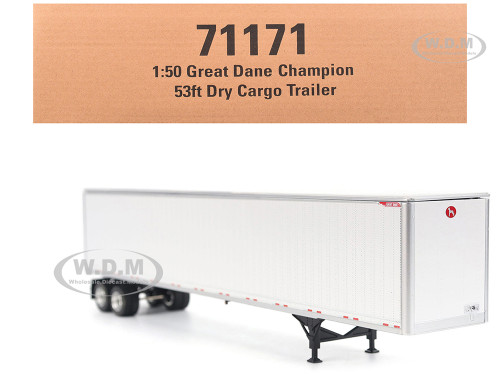
Cargo trailers are designed to transport goods, equipment, materials, and other loads from one location to another. Unlike trailers built for a highly specialized purpose, a cargo trailer is generally intended for flexible freight transportation. Depending on its configuration, a cargo trailer may be enclosed or open, and it can be used for everything from commercial freight and deliveries to equipment and general-purpose hauling.
At DiecastModelsWholesale.com, the Cargo category is part of our Trailer collection and features scale models representing trailers used to move cargo and general freight. These models can be a useful addition to collections focused on commercial trucks, transportation, logistics, construction, or realistic trucking displays.
What Is a Cargo Trailer?
A cargo trailer is an unpowered trailer designed to carry goods or other loads. It is pulled by a truck, tractor, pickup, or another suitable towing vehicle depending on its size and configuration.
Cargo trailers can take many forms. A small enclosed trailer may be used for tools, supplies, or recreational equipment, while a large commercial semi-trailer can carry substantial quantities of packaged goods over long distances.
Common cargo trailer configurations include:
- Enclosed cargo trailers
- Dry freight trailers
- Box and van trailers
- Flatbed cargo trailers
- Utility cargo trailers
- Specialized freight trailers
- Commercial semi-trailers
The term cargo trailer therefore describes a broad transportation category rather than one single trailer design. The construction and equipment vary according to the type of freight being transported.
For diecast collectors, this variety makes cargo trailers particularly useful. They can represent many different aspects of the transportation industry and can be paired with appropriately scaled trucks and tractors to create complete freight-hauling combinations.
Cargo Trailers and Commercial Trucking
Cargo trailers are fundamental to modern road transportation. A truck tractor provides the engine, cab, drivetrain, and fifth-wheel connection, while the trailer provides the cargo-carrying space.
In a typical tractor-trailer combination, the front of the semi-trailer rests partly on the tractor's fifth wheel. The trailer's remaining weight is carried by its own axles toward the rear.
This arrangement allows the tractor and trailer to function as a flexible transportation system. A tractor can be separated from one trailer and connected to another, while trailers can remain at loading docks or freight terminals while another tractor handles the next movement.
Collectors interested in complete commercial combinations can pair cargo trailers with models from the Truck category, as well as Semi and Truck Tractor models.
Types of Cargo Trailers
The cargo category can encompass several trailer designs, each suited to different transportation requirements.
Enclosed Cargo Trailers
Enclosed trailers protect their contents from weather and provide a secure enclosed space. Smaller versions are commonly used for tools, equipment, supplies, and commercial work, while larger enclosed semi-trailers are used for general freight.
Their enclosed body also provides a large exterior surface that may carry company names, fleet numbers, advertising, or other graphics. These details can be particularly interesting on scale models.
Dry Freight Trailers
Dry freight trailers are among the most recognizable commercial cargo trailers. Their enclosed bodies are designed to carry general freight that does not require temperature control.
Typical loads can include packaged products, manufactured goods, consumer merchandise, household products, and other non-refrigerated freight.
Flatbed Cargo Trailers
Flatbed trailers provide an open platform rather than an enclosed cargo body. This makes them useful for loads that are oversized, unusually shaped, or better handled by crane or forklift.
Cargo can include building materials, machinery, steel products, lumber, and industrial equipment.
Collectors can explore the Flatbed category for more specialized open-deck trailer models.
Utility Cargo Trailers
Smaller utility cargo trailers can be used for a wide range of everyday hauling tasks. They may feature open decks, side rails, ramps, or enclosed bodies depending on their intended purpose.
These trailers can be paired with pickup trucks and other light-duty vehicles, making them suitable for smaller-scale transportation displays.
The History of Cargo Trailers
The history of cargo trailers is closely connected to the development of road transportation itself. Before motor vehicles became widespread, wagons and carts provided the primary means of moving freight over land. The arrival of motor trucks created new opportunities for faster and more flexible transportation.
Early motor trucks frequently carried cargo directly on their own chassis. As transportation needs expanded, separate trailers became increasingly useful because they allowed larger loads to be moved and enabled the towing vehicle to be used independently.
The development of the semi-trailer was particularly important. In the early 20th century, manufacturers and trucking operators refined the concept of a trailer supported partly by the towing vehicle. This arrangement eventually became a defining feature of long-distance commercial trucking.
Improved roads, larger trucks, standardized couplings, and the expansion of highway networks further encouraged the use of tractor-trailer combinations. By the postwar period, trucking had become an important component of the North American freight system.
Cargo trailers continued to evolve alongside the industry. Enclosed bodies became increasingly standardized, while specialized trailers were developed for refrigerated products, automobiles, livestock, bulk materials, heavy equipment, and other specific loads.
Cargo Trailers in the Modern Freight Industry
Modern cargo trailers are engineered around efficiency, payload requirements, durability, and the type of freight they carry. Commercial trailers may incorporate aerodynamic features, lightweight construction, multiple axles, improved suspension systems, durable flooring, specialized doors, and other equipment.
Trailer configuration can also vary according to the freight network. Local delivery trailers may be designed for frequent loading and unloading, while long-haul trailers are optimized for highway transportation.
For collectors, these differences provide an opportunity to build a collection around particular eras or transportation themes. A vintage commercial truck and trailer can represent an earlier period of highway freight, while a contemporary tractor and enclosed trailer can recreate a modern logistics operation.
What to Look for in Cargo Trailer Models
When choosing a cargo trailer diecast model, collectors may want to consider both the trailer itself and how it will fit into an existing collection.
Trailer Body
The body is one of the most noticeable features. Enclosed trailers may have smooth or ribbed sides, rear doors, side doors, roof details, and other features associated with their particular design.
Axles and Running Gear
The number and placement of axles affect both the appearance and proportions of a commercial trailer. Tires, wheels, suspension components, mudguards, and other chassis details can add realism.
Landing Gear
Semi-trailers use landing gear to support the front of the trailer when it is disconnected from the tractor. This is an especially recognizable detail on commercial trailer models.
Doors and Loading Equipment
Rear swing doors, roll-up doors, side doors, ramps, and other loading features can distinguish one cargo trailer from another.
Fleet Graphics and Livery
Commercial trailers often carry company graphics, logos, advertising, identification numbers, or distinctive color schemes. For collectors, these markings can make a particular model interesting because they connect the trailer to a recognizable transportation company, industry, or era.
Scale Compatibility
Scale is especially important when combining a cargo trailer with a truck tractor. Common scales across commercial diecast models include 1/18, 1/24, 1/32, 1/43, 1/50, and 1/64, although the available scale varies by model.
A 1/64 trailer, for example, can be useful for a compact trucking display, while 1/50 is particularly common among detailed commercial and heavy-equipment models. Always check the individual product specifications when matching a trailer to another vehicle.
Building a Truck and Cargo Trailer Display
A cargo trailer becomes even more interesting when displayed as part of a complete tractor-trailer combination.
A conventional tractor can be positioned in front of an enclosed cargo trailer to recreate a long-haul freight truck. Alternatively, a cargo trailer can be displayed at a loading dock, warehouse, distribution center, truck yard, or roadside transportation scene.
Collectors can expand a freight-themed display with additional DMW categories such as Truck, Trailer, Box, Semi, Day Cab, and Sleeper Cab Truck Tractor.
The combination of vehicles can also help demonstrate how different types of trucks and trailers serve different roles. A day cab can represent local or regional work, while a sleeper tractor can suggest long-distance highway freight.
Cargo Trailers for Diecast Collectors
Trailers add an important dimension to a commercial vehicle collection because they show what a truck was built to transport. A tractor without a trailer can represent the vehicle itself, but adding a properly matched cargo trailer creates a more complete working combination.
Cargo trailer models are also useful for collectors who enjoy realistic dioramas. A trailer backed into a warehouse, positioned beside a loading dock, or attached to a tractor in a truck yard can provide context for other vehicles and equipment in the scene.
Collectors may also choose cargo trailers based on historical interest. Vintage-style designs, classic truck combinations, modern fleet trailers, and specialized freight equipment can each represent different periods in the development of road transportation.
Find Cargo Trailer Diecast Models
Cargo trailers are an essential part of the trucking and freight industry, and their scale-model counterparts provide collectors with a versatile way to expand commercial vehicle displays. From enclosed freight trailers to open cargo-hauling designs, each configuration reflects a different approach to moving goods by road.
Browse the Cargo category at DiecastModelsWholesale.com to explore available cargo trailer models and find the right addition to your collection. Pair your trailer with a matching truck or tractor to create a complete freight-hauling display, or add it to a larger transportation diorama.